Every time you go in for an oil change, the technician asks the same question: “Full synthetic, or regular?” For a lot of drivers, that’s exactly where the hesitation starts. Two bottles sit side by side on the shelf, the packaging looks almost identical — yet one can cost nearly twice as much. So what, exactly, are you paying for? This article breaks down the real differences between synthetic and mineral engine oil, so that by the end you’ll have a clear idea of which one your car actually needs.
Synthetic vs Mineral Oil: Where the Real Difference Begins
Before we talk performance, it helps to understand where these two oils come from in the first place.
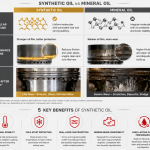
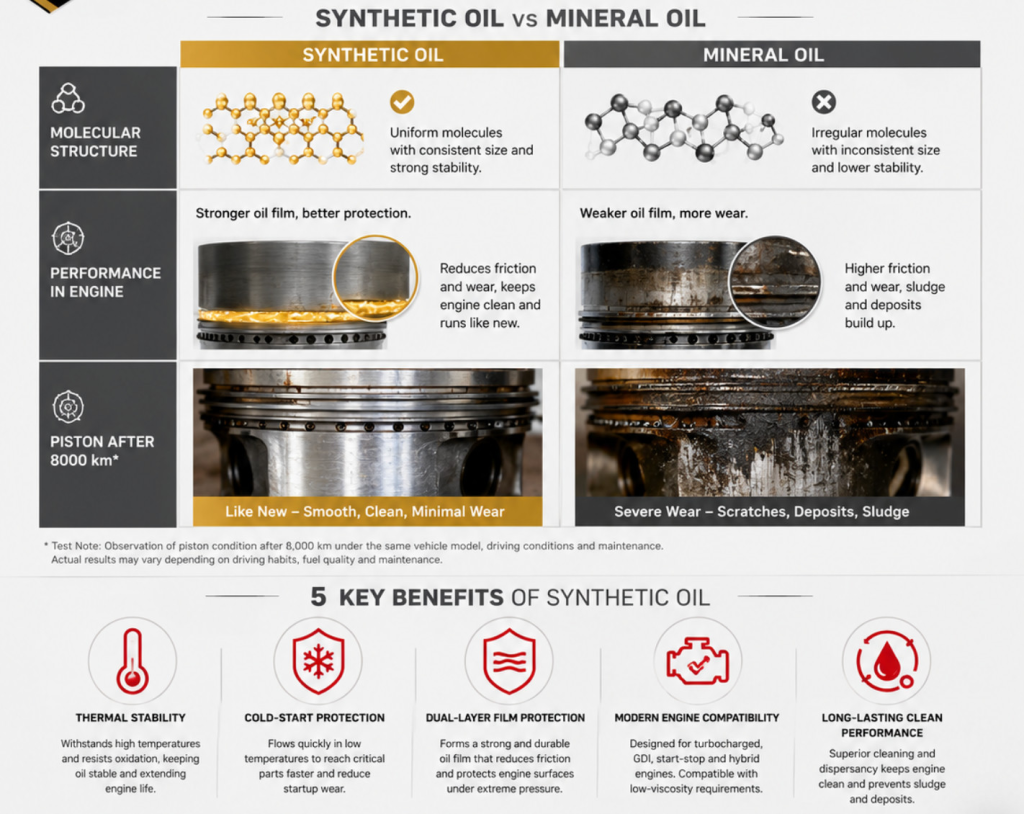
Around 70–80% of any bottle of engine oil is base oil; the rest is a package of additives for anti-wear, detergency and oxidation resistance. What really determines the quality of an oil is its base oil. Mineral base oil comes straight from crude — distilled and refined through a mature, low-cost process. But it carries one unavoidable flaw: its molecules vary in size and the structure is irregular. Picture a pile of stones of all different sizes.
Synthetic oil takes a different route. Its base oil is built through chemical synthesis in a plant, so the molecules are arranged neatly and are almost uniform in size — more like rows of identical, well-ordered spheres.
That small structural difference is easy to overlook, but it’s exactly what shows up where it matters most: inside the engine.
Same 8,000 km — Pistons in a Completely Different League
The more uniform the molecules, the more stable the oil film. In a hot, high-pressure cylinder, synthetic oil can hold up a thicker, more continuous protective film, keeping metal surfaces like the piston and cylinder wall apart and reducing direct friction. Mineral oil forms a thinner film that breaks down more easily under heat, so metal-on-metal contact happens more often — and wear climbs accordingly.
Oxidation resistance is the other big gap. Oil that sits in high heat for a long time slowly oxidizes and degrades, producing sludge and carbon deposits. Mineral oil’s loose molecular structure can’t take prolonged heat and ages early; synthetic oil is far more stable and resists oxidation much better, so over the same distance the inside of the engine stays noticeably cleaner.
One comparison makes the point well: same car model, same road conditions, same maintenance habits. After a full 8,000 km, the pistons were pulled and inspected. The engine running synthetic oil had a clean, smooth piston surface with very little carbon — essentially like new. The one on mineral oil showed scored cylinder walls, sludge buildup and layer upon layer of carbon, with wear you could see at a glance. Real-world results will of course depend on driving habits, fuel quality and operating environment — but the direction of the gap is very real.
Where Full-Synthetic Oil Really Earns Its Price
Break the reasoning down and the advantages of synthetic oil cluster around five areas.
The most direct is thermal stability. Under hard driving, oil temperature easily climbs past 150°C; in that range synthetic oil resists oxidizing and thinning, holds its viscosity, and keeps the engine running more consistently.
Cold starts are an often-overlooked moment. After a winter night, the oil is “frozen” down in the sump. Mineral oil turns thick and sluggish in the cold, and for the first few seconds the oil pump has to work hard to draw it up — during which the engine is running almost dry. A lot of wear happens precisely in those first seconds of a cold start. Synthetic oil flows far better at low temperature, reaching critical parts like the valvetrain and camshaft faster and keeping start-up wear to a minimum.
Film strength is another clear difference. Turbocharging and high rpm place heavy demands on the oil film; the protective layer synthetic oil forms is tougher and far less likely to be squeezed through under extreme pressure, so the parts that need protecting stay protected.
Compatibility with modern engines is a big reason synthetic oil keeps gaining ground. Turbocharging, gasoline direct injection (GDI), hybrids and stop-start systems are now almost standard on new cars, and these engines generally demand low-viscosity oils and run under harsher conditions — exactly where synthetic oil has the clear edge.
Last is cleaning performance. A good synthetic oil has stronger detergency and dispersancy, holding combustion byproducts in suspension instead of letting them clump and settle. Over time the inside of the engine stays cleaner, with less sludge and carbon.
So Is Mineral Oil Obsolete?
Not quite — there’s no need to write mineral oil off entirely.
If you drive an older car, mostly commute around town without revving it hard, and change your oil on a tight schedule, mineral oil is perfectly adequate; there’s no reason to pay extra just for the words “full synthetic.” For short oil-change intervals and value-focused use, mineral oil still has its place.
Where mineral oil genuinely falls short is with long oil-change intervals, high heat and heavy loads, and modern engines. Those scenarios magnify its weaknesses — so when the situation calls for synthetic, don’t cut that corner.
How to Choose for Your Own Car
The safest move is to start with your owner’s manual. The manufacturer specifies the recommended oil viscosity (such as 5W-30 or 0W-20) and the required standards; follow that and you’ll rarely go wrong.
Within what the manufacturer requires: if your car is turbocharged, runs in extreme conditions (lots of highway miles, hot summers, harsh winters), or you plan to stretch your oil-change interval, synthetic oil is generally the smarter choice — a little more per bottle, but better protection and longer intervals, which can work out even on cost and means real peace of mind for the engine over the long run.
Katmoto has always focused on synthetic lubricants, with a product line covering different viscosity grades and engine types — whether for everyday commuting or a high-performance turbo car, there’s a matching synthetic option. When you choose, check the viscosity and certification standards, factor in how you actually drive, and you’ll land on the right bottle.
At the end of the day, oil is the lifeblood of an engine. Whether a given oil is good may not be obvious in the short term, but over time the difference is written all over the engine’s lifespan and condition. That’s a calculation worth taking the time to get right.