For engine oil importers, 2026 is not simply another packaging update. It is a portfolio-planning year. API SQ and ILSAC GF-7 are now the current performance benchmarks for modern gasoline engine oils, while ILSAC GF-6A and GF-6B are scheduled to become obsolete on October 1, 2026.
That creates a practical question for distributors. This API SQ vs API SP comparison asks whether you should continue buying SP/GF-6 products, move immediately to SQ/GF-7, or carry both during the transition.
The short answer is that there is no single correct choice for every market. A sound decision depends on the local vehicle population, viscosity demand, OEM requirements, customer price bands and the speed at which workshops accept a new specification. What should not be delayed is understanding the change and building a controlled transition plan.
Key takeaway: API SQ raises the protection requirements for modern gasoline engines, while ILSAC GF-7 adds the fuel-economy and emissions-system requirements used for eligible passenger-car viscosity grades. Importers should treat specification and viscosity as two separate decisions and verify both before ordering.
API SQ vs API SP: what changed?
API SP entered the market in 2020 and remains a current category for many 2025 and older gasoline engines. It introduced important protection for turbocharged gasoline direct-injection engines, including low-speed pre-ignition (LSPI) control and timing-chain wear protection.
API SQ, first licensed in March 2025, builds on that foundation. According to the American Petroleum Institute’s current Motor Oil Guide, the new category is designed to provide protection against both fresh- and aged-oil LSPI, along with improved timing-chain wear protection, improved high-temperature deposit protection for pistons and turbochargers, and control of sludge and varnish.
The words “aged-oil” matter. An engine oil does not operate in laboratory-fresh condition for an entire service interval. Heat, oxidation, fuel dilution and contamination gradually change the lubricant. A standard that evaluates protection after oil ageing therefore addresses a more realistic part of the drain cycle—especially for downsized turbocharged engines, hybrids and vehicles used in repeated stop-start operation.
| Decision area | API SP / ILSAC GF-6 | API SQ / ILSAC GF-7 | Why it matters to an importer |
|---|---|---|---|
| Market introduction | 2020 generation | March 2025 generation | SQ/GF-7 gives the portfolio a current specification story for new vehicles. |
| LSPI protection | Protection for modern gasoline engines | Protection against fresh- and aged-oil LSPI | Relevant to TGDI engines throughout more of the oil’s working life. |
| Timing-chain wear | Timing-chain wear protection | Improved timing-chain wear protection | Supports a clearer durability message for modern engine platforms. |
| High-temperature deposits | Established deposit-control requirements | Improved protection for pistons and turbochargers | Useful in hot climates, heavy traffic and high-load operation, while still following the OEM oil requirement. |
| Fuel economy and emissions systems | GF-6 resource-conserving requirements | Improved requirements under GF-7 | Important for newer gasoline and hybrid vehicles and for future-facing retail positioning. |
| 2026 status | GF-6A/GF-6B scheduled to become obsolete on October 1, 2026 | GF-7A/GF-7B current | Distributors need a stock, label and sales-training transition plan. |
API SQ and ILSAC GF-7 are related—but they are not identical
This is where many product listings become confusing. API SQ is the gasoline engine-oil service category. ILSAC GF-7 is the companion passenger-car standard that combines engine protection with requirements such as improved fuel economy, emissions-system protection and low-temperature pumpability.
API states that an API SQ “Resource Conserving” oil matches ILSAC GF-7A when the relevant licensing and viscosity requirements are met. However, an oil labelled API SQ is not automatically an ILSAC GF-7 oil. The viscosity grade and the exact claim on the licensed product still have to be checked.
GF-7A and GF-7B: the distinction buyers must preserve
- ILSAC GF-7A is the mainstream category for eligible passenger-car viscosity grades. API advises using GF-7A where GF-6A was recommended.
- ILSAC GF-7B applies only to SAE 0W-16. API advises using GF-7B where GF-6B was recommended.
- The API Starburst mark is associated with the mainstream ILSAC category, while the Shield identifies the 0W-16 B category.
- Neither mark allows a distributor to ignore viscosity. SAE 0W-16 should only be used where the vehicle manufacturer permits 0W-16.
A simple purchasing rule follows: never approve a product from a phrase such as “latest API technology” alone. Confirm the brand, viscosity grade, API category, ILSAC category and any required OEM specification as one complete application package.
Does API SQ replace API SP?
For many gasoline vehicles that call for an earlier API category, a correctly licensed API SQ oil can provide a current performance level. ILSAC’s transition guidance is especially clear: GF-7A is used where GF-6A was recommended, and GF-7B is used where GF-6B was recommended.
But “newer category” does not mean “universal oil.” Three checks still come first:
- Use the viscosity grade specified by the vehicle manufacturer. A modern 0W-16 oil is not a substitute for 0W-20, 5W-30 or a high-HTHS European oil unless the OEM explicitly allows it.
- Preserve OEM-specific requirements. An API SQ claim does not automatically satisfy an ACEA category or a manufacturer approval from Toyota, Volkswagen, Mercedes-Benz, BMW or another OEM.
- Check the exact licensed product. Certification applies to the named brand and viscosity grade in the licensing record—not to every oil made by the same supplier.
API SP therefore does not become unusable overnight. It can remain relevant for price-sensitive channels and existing vehicle populations during the transition. The commercial risk is continuing to build long-term inventory around an older ILSAC generation without a plan for labels, sales language and replacement SKUs after October 2026.
ILSAC GF-7A vs GF-6A: the October 2026 transition
The API Motor Oil Guide lists GF-6A and GF-6B as current categories that are scheduled to become obsolete on October 1, 2026. For an importer, that date affects more than the formula. It can touch packaging artwork, certification marks, distributor catalogues, online product pages, workshop training and replenishment timing.
A practical transition plan should separate three types of inventory:
- Sell-through stock: existing correctly labelled GF-6 products that can be sold through the normal channel under applicable rules.
- Transition stock: high-volume grades where GF-7 packaging and technical documents should be introduced first.
- Legacy or specialist stock: grades governed mainly by API, ACEA or OEM requirements rather than by ILSAC GF-7.
Importers should agree in writing with the supplier which formula, label version and licence status will apply to each purchase order. “Same product, new sticker” is not an adequate technical answer.
How to build the right API SQ portfolio for your market
The best engine-oil portfolio is not the one with the most SKUs. It is the smallest range that covers the largest share of real, verified applications without creating workshop confusion.
Start with local registration data, workshop interviews and current sales by make, model, year, viscosity and specification. Then divide the range into a core layer for fast-moving modern vehicles, a coverage layer for European and older vehicles, and a specialist layer for low-volume applications.
| Target region | Typical portfolio challenge | Practical distributor response |
|---|---|---|
| Central Asia | Large seasonal temperature range and a mixed vehicle fleet | Give cold-start performance real weight, but keep viscosity and OEM requirements model-specific. Build modern 0W/5W grades alongside clearly separated older-vehicle products. |
| Latin America | Wide variation in climate, altitude, vehicle age and purchasing power | Avoid a single “regional” viscosity. Use a core GF-7 range for newer Japanese, Korean, Chinese and American vehicles, supported by high-mileage and European-specification tiers where local car-parc data justifies them. |
| Middle East | High ambient heat, dust, extended idling and stop-start traffic | Prioritise oxidation stability, deposit control and credible technical documentation. Do not assume thicker oil is automatically safer; the OEM viscosity remains the starting point. |
| Southeast Asia | Heat, humidity, traffic congestion, short trips and fast growth in Japanese and Asian vehicle platforms | Make modern 0W-20 and 5W-30 coverage easy for workshops to understand, then add 0W-16 where hybrid and new-car demand supports sufficient turnover. |
Across all four regions, the same discipline applies: climate can influence operating severity, but it should not be used to override the engine manufacturer’s required viscosity or specification.
A seven-point purchasing checklist for engine oil importers
- Map the local car parc. Rank the leading makes, models, model years, engine technologies and required viscosities before selecting SKUs.
- Verify the performance claim. Search the official API Engine Oil Licensing and Certification System directory for the exact brand and viscosity when a product is presented as API licensed.
- Match the correct A/B category. GF-7B is only for SAE 0W-16. Do not allow GF-7A, GF-7B and “API SQ” to be treated as interchangeable marketing phrases.
- Request controlled documents. Review the current TDS, SDS, COA format, production batch identification and product-change notification process. KATMOTO’s document and testing approach is outlined on its Quality & Certifications page.
- Check claims outside API. ACEA performance claims and OEM approvals require their own evidence. One certification does not prove another.
- Plan the GF-6 sell-through. Agree the final GF-6 orders, the first GF-7 packaging date and the technical training needed before October 1, 2026.
- Protect channel clarity. Give workshops a concise application chart that explains viscosity, API/ILSAC level and vehicle use without promising that one oil fits every engine.
How KATMOTO can support the specification transition
KATMOTO’s passenger-car synthetic engine oil range is structured to help distributors cover modern gasoline and hybrid applications with clear viscosity and performance positioning.
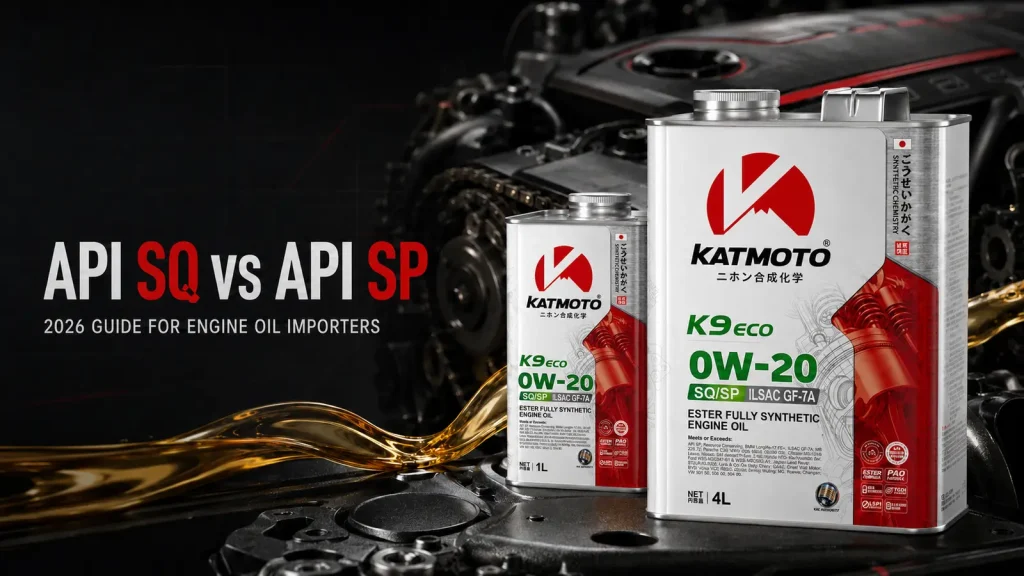
K9 ECO 0W-20 is positioned for hybrid and modern gasoline vehicles requiring SAE 0W-20 and the API SQ / ILSAC GF-7A performance level. For other viscosity grades, distributors should compare the exact product page and current technical documents with the official API EOLCS listing before confirming the specification or printing certification marks.
KATMOTO can work with importers to build an application-led range while preserving the correct viscosity and specification for each vehicle group. This is particularly useful when a market needs to carry current GF-7 products alongside GF-6 sell-through stock, European specifications and high-mileage grades during the same transition period.
Frequently asked questions
Is API SQ better than API SP?
API SQ is the newer category and adds enhanced requirements, including protection against fresh- and aged-oil LSPI, improved timing-chain wear protection and improved high-temperature deposit protection. The right oil must still match the vehicle’s viscosity and any OEM-specific specification.
Can API SQ engine oil be used where API SP is recommended?
Often, a correctly licensed API SQ oil of the correct viscosity can cover an earlier API gasoline category. However, always follow the vehicle manufacturer’s manual and confirm any separate ACEA or OEM requirement.
Is ILSAC GF-7A backward compatible with GF-6A?
Yes. API’s current Motor Oil Guide advises using GF-7A where GF-6A is recommended. The viscosity grade must still match the vehicle requirement.
What is the difference between GF-7A and GF-7B?
GF-7A is the mainstream ILSAC category for eligible passenger-car viscosity grades. GF-7B applies only to SAE 0W-16 and is identified by the API Shield certification mark.
When do GF-6A and GF-6B become obsolete?
API’s current guide schedules both categories to become obsolete on October 1, 2026. Importers should confirm transition details and licence status with their supplier before ordering packaging intended for long-term use.
How can an importer verify an API claim?
Check the official API Engine Oil Licensing and Certification System directory for the exact marketer, brand name and viscosity grade. Then compare the result with the product label and current technical documents. A general supplier certificate is not enough to verify every SKU.
Prepare the portfolio before the label becomes urgent
The move from API SP/GF-6 to API SQ/GF-7 is a technical upgrade, but for distributors it is also a stock-management and market-education project. The strongest importers will not simply replace one badge with another. They will use the transition to simplify their ranges, improve application accuracy and give workshops a clearer reason to choose each product.
If you are planning a 2026 passenger-car engine oil portfolio for Central Asia, Latin America, the Middle East or Southeast Asia, KATMOTO can help evaluate the required viscosity mix, technical documents and channel positioning. Apply to become a KATMOTO distributor or contact our team to discuss your market.
Technical references
- American Petroleum Institute, API Motor Oil Guide.
- American Petroleum Institute, EOLCS Licensee Directory.
- American Petroleum Institute, API 1509: Engine Oil Licensing and Certification System.
Editorial note: This article is intended for general technical and portfolio-planning guidance. Always follow the vehicle manufacturer’s current lubricant recommendation and verify certification or approval claims against the relevant official record.